
The phrase "no skills" might feel like a dead end, but in 2026's AI-driven job market, it's actually a launching pad. The artificial intelligence revolution has created unprecedented opportunities for career changers, recent graduates, and anyone willing to learn. The best part? You don't need a computer science degree or years of technical experience to break into high-paying AI roles. What you need is a strategic approach, the right resources, and a commitment to building marketable competencies that employers desperately want.
Why Having No Skills Is Actually Your Competitive Advantage
Starting with no skills means you're not locked into outdated methods or legacy thinking. You get to build your expertise using the latest AI tools, frameworks, and workflows from day one.
Traditional career paths required years of formal education before entering the workforce. Now, AI professionals are learning on demand, building portfolios through real projects, and getting hired based on demonstrable capabilities rather than credentials alone.
Here's what makes 2026 different:
- AI tools have democratized learning, making complex concepts accessible to complete beginners
- Companies prioritize practical skills over theoretical knowledge
- Remote work has opened global opportunities regardless of location
- Certification programs offer faster paths to employment than traditional degrees
The U.S. Department of Education’s Employability Skills Framework emphasizes that foundational competencies can be developed systematically, even without prior experience. This structured approach to skill building is exactly what transforms someone with no skills into a competitive job candidate.

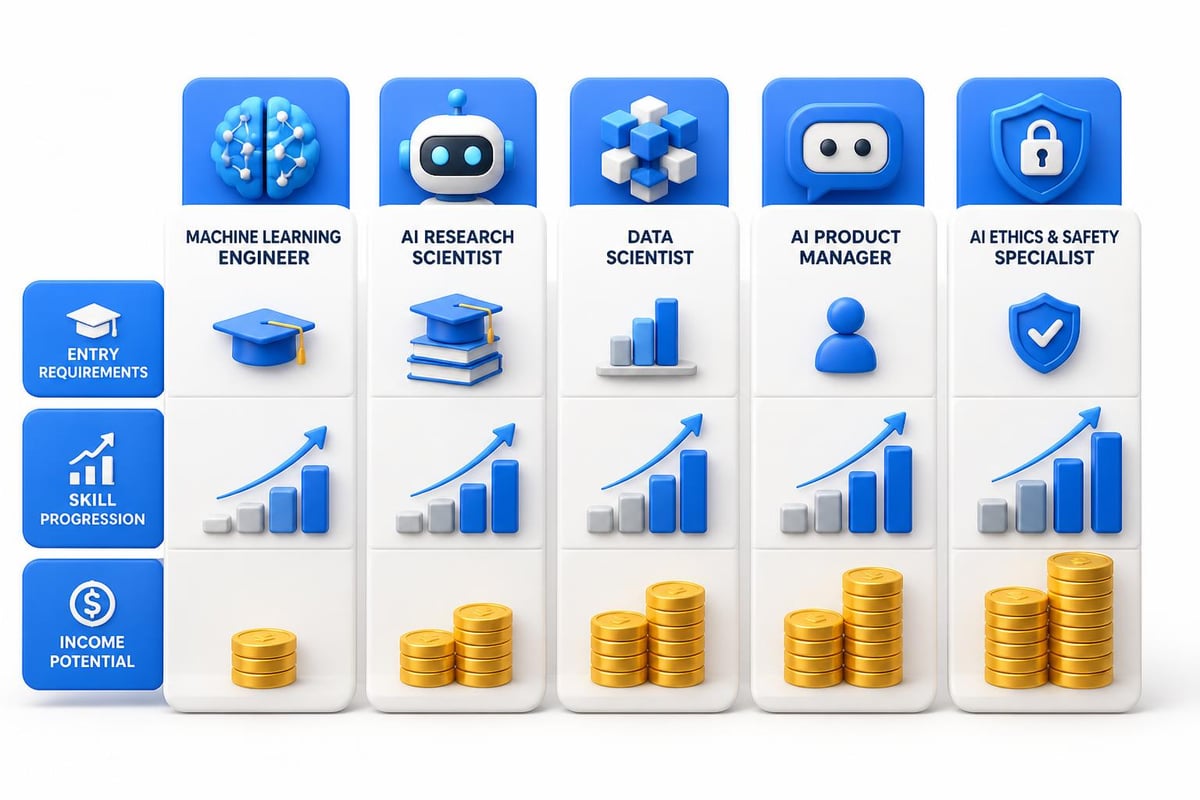
The Five AI Career Paths Perfect for Beginners With No Skills
Not all AI careers require coding expertise or advanced mathematics. Several high-demand roles focus on business applications, creative problem-solving, and strategic thinking.
Prompt Engineering: The Gateway to AI Careers
Prompt engineering is the art and science of communicating effectively with AI systems to produce desired outputs. This role requires no programming background, just strong communication skills and logical thinking.
Core responsibilities include:
- Designing prompts that generate accurate, useful AI responses
- Testing and refining AI outputs for quality and relevance
- Documenting best practices for team use
- Collaborating with developers to improve AI model performance
Salaries for prompt engineers range from $75,000 to $150,000 annually, making this an exceptional entry point for those starting with no skills.
AI Training Specialist
AI systems learn from human feedback. Training specialists teach AI models to recognize patterns, understand context, and produce better results. This role emphasizes attention to detail and domain knowledge rather than technical skills.
| Role Aspect | Requirements | Salary Range |
|---|---|---|
| Education | High school diploma or equivalent | $55,000 – $95,000 |
| Technical Skills | Basic computer literacy | Entry to Mid-level |
| Key Competency | Pattern recognition and consistency | Growing demand |
Automation Consultant
Businesses are racing to implement AI automation but lack internal expertise to identify opportunities and implement solutions. Automation consultants bridge this gap by understanding business processes and recommending AI tools to increase efficiency.
You don't need to build the automation yourself. Your value comes from understanding workflows, spotting inefficiencies, and connecting problems with existing AI solutions.
AI Content Strategist
Content creation has been revolutionized by AI, but strategy still requires human insight. AI content strategists plan content calendars, define brand voice for AI tools, and ensure outputs align with business goals.
This role blends creativity with analytical thinking, making it perfect for writers, marketers, or communicators transitioning from traditional fields with no technical skills.
Data Annotation Specialist
Every AI model needs labeled data to learn from. Data annotation specialists review images, text, audio, or video and tag them with relevant labels. While entry-level, this role offers inside exposure to AI development and clear advancement paths.
According to Coursera’s research on professional skills, workplace competencies like attention to detail and communication often matter more than technical knowledge in these emerging roles.
The 90-Day Plan to Go From No Skills to Job-Ready
Transforming from no skills to employment-ready doesn't require years. With focused effort, you can build a competitive foundation in three months.
Month One: Foundation and Exploration
- Understand AI fundamentals through free resources (YouTube, podcasts, introductory articles)
- Experiment with AI tools like ChatGPT, Midjourney, and Claude to see capabilities firsthand
- Identify your target role based on interests and natural strengths
- Join AI communities on Discord, LinkedIn, or Reddit to learn from practitioners
- Set specific learning goals with measurable outcomes
Spend 10-15 hours weekly during this phase. The goal isn't mastery but orientation and commitment.
Month Two: Skill Building and Practice
This phase focuses on developing job-specific competencies through structured learning and hands-on projects.
- Enroll in targeted courses for your chosen career path
- Complete 3-5 practical projects you can showcase
- Start building a portfolio website or LinkedIn presence
- Practice explaining AI concepts in simple terms
- Connect with professionals already in your target role
Georgia Tech’s Career Center provides excellent frameworks for developing transferable skills that complement technical AI knowledge, even when you're starting with no skills.
Month Three: Portfolio Development and Job Search
The final month transitions from learning to earning. You're building proof of capability while actively pursuing opportunities.
Your action items:
- Polish 2-3 portfolio projects with detailed case studies
- Optimize your LinkedIn profile for AI roles
- Apply to 5-10 positions weekly
- Attend virtual AI conferences or webinars
- Consider freelance projects to gain experience and testimonials
Many people starting with no skills get their first paid opportunity before the 90 days end, often through freelance platforms or contract positions that lead to full-time roles.
The Tools and Certifications That Accelerate Your Journey
Having the right resources dramatically shortens the path from no skills to employable. Focus on practical tools you'll use daily and certifications employers recognize.
Essential AI Tools Every Beginner Should Master
| Tool Category | Recommended Options | Primary Use Case |
|---|---|---|
| AI Assistants | ChatGPT, Claude, Gemini | Prompt engineering, content creation |
| Image Generation | Midjourney, DALL-E, Stable Diffusion | Visual content, design assistance |
| Automation | Zapier, Make, n8n | Workflow automation |
| Data Tools | Google Sheets with AI plugins, Airtable | Data organization and analysis |
| Learning Platforms | Coursera, Udemy, YouTube | Skill development |
Start with free versions to build competency before investing in premium subscriptions. The Mammoth Club provides structured AI training designed specifically for beginners, offering guided lessons and real-world projects that help you build job-ready skills faster than self-study alone.

Certifications That Employers Actually Value
Not all certificates carry equal weight. Focus on credentials that demonstrate practical capability rather than theoretical knowledge.
High-impact certifications for 2026:
- Google AI Essentials: Free, beginner-friendly, recognized globally
- Microsoft AI Fundamentals (AI-900): Validates foundational AI knowledge
- IBM AI Engineering Professional Certificate: Project-based learning with portfolio pieces
- Prompt Engineering Certification: Specialized credential for this growing field
- AI+ Marketing/Sales Certifications: Industry-specific applications that command premium salaries
These certifications range from free to $300, making them accessible even when starting with no skills and limited budget.
Building Your AI Portfolio With Zero Experience
The biggest obstacle for those with no skills isn't ability; it's proof. Your portfolio solves this by demonstrating what you can do rather than just claiming competency.
Three Portfolio Projects That Get You Hired
Project One: Prompt Library Documentation
Create a comprehensive collection of prompts for a specific use case (customer service, social media, research, etc.). Document each prompt's purpose, variables, and expected outputs.
This showcases your understanding of prompt engineering, attention to detail, and ability to create valuable resources for teams.
Project Two: Automation Workflow Case Study
Identify a repetitive business process and design an AI automation solution. Even if you don't implement it technically, document the current workflow, proposed solution, expected time savings, and ROI calculation.
This demonstrates business thinking, problem identification, and solution design skills that companies desperately need.
Project Three: AI Tool Comparison Analysis
Compare three AI tools for a specific function (writing assistants, image generators, coding helpers). Test each thoroughly, document strengths and weaknesses, and provide clear recommendations.
This shows analytical skills, technical curiosity, and the ability to evaluate tools critically, all valuable competencies for AI roles.
Coursera’s guide to skill development emphasizes that hands-on projects accelerate learning far more effectively than passive consumption of content, especially for individuals building from no skills.
Networking Strategies When You Have No Skills to Offer (Yet)
Traditional networking advice assumes you have expertise to exchange. When you're starting with no skills, you need different strategies that create value through curiosity, effort, and genuine interest.
The "Document Your Learning" Approach
Share your learning journey publicly through LinkedIn posts, Twitter threads, or blog articles. Document challenges, breakthroughs, and resources you find helpful.
Why this works:
- Demonstrates commitment and growth mindset
- Attracts mentors who remember their own beginnings
- Creates content that helps other beginners (instant value)
- Builds your personal brand before you have credentials
Post 2-3 times weekly about what you're learning, tools you're trying, or concepts you're mastering.
The "Volunteer Your New Skills" Method
Non-profits, small businesses, and solopreneurs need AI help but lack budgets for professionals. Offer your emerging skills in exchange for testimonials, referrals, and real-world experience.
You might automate their email responses, create AI-generated social media content, or build prompt templates for their specific needs. The work goes in your portfolio, and they get free value.
The "Informational Interview" Strategy
Reach out to AI professionals not for job opportunities but for 15-minute conversations about their career path. Prepare thoughtful questions, respect their time, and follow up with thanks.
Most people enjoy sharing their journey, especially with earnest learners. These conversations often lead to mentorship, job referrals, or insider tips that accelerate your progress.
Overcoming the Mental Barriers of Starting With No Skills
The technical challenges of learning AI pale in comparison to the psychological obstacles many face when starting from zero.
Imposter syndrome intensifies when:
- You see others with impressive credentials
- Job postings list requirements you don't have
- You make mistakes in your early projects
- Your learning feels slower than you hoped
Recognize that everyone in AI started somewhere, and the field is so new that even "experts" have only 3-5 years of experience. The gap between you and employed AI professionals is smaller than you think.
Reframing "No Skills" as "Fresh Perspective"
Companies stuck in legacy thinking often miss AI opportunities right in front of them. Your lack of preconceptions becomes an asset when identifying automation possibilities or suggesting innovative applications.
Your beginner's mindset asks questions veterans skip. Your fresh eyes spot inefficiencies normalized by experience. Your outsider perspective connects AI capabilities to problems others overlook.
Frame your lack of experience as curiosity and adaptability rather than deficiency.
The Income Timeline: What to Expect Month by Month
Setting realistic financial expectations prevents discouragement while maintaining motivation through your transition from no skills to income-generating capability.
| Timeline | Income Source | Expected Range | Key Focus |
|---|---|---|---|
| Month 1-2 | None (learning phase) | $0 | Foundation building |
| Month 3-4 | Freelance micro-tasks | $200-$800/month | First paid work |
| Month 5-6 | Contract projects | $1,500-$3,500/month | Portfolio expansion |
| Month 7-9 | Part-time AI role or multiple clients | $3,000-$5,500/month | Specialization |
| Month 10-12 | Full-time position or established freelance | $5,000-$8,000/month | Career establishment |
These ranges reflect conservative estimates. Many individuals exceed these figures, especially when focused on high-demand niches like prompt engineering or AI automation consulting.
The key is treating your first 3-6 months as an investment period rather than expecting immediate returns. This mindset shift prevents premature discouragement when results don't materialize instantly.
Avoiding the Common Traps That Derail Beginners
Starting with no skills makes you vulnerable to specific pitfalls that waste time, money, and momentum.
Tutorial Hell: Endlessly consuming courses without applying knowledge. Solution: Follow the 70/20/10 rule (70% doing projects, 20% learning new concepts, 10% consuming general content).
Shiny Object Syndrome: Jumping between AI tools, courses, and career paths without mastering any. Solution: Commit to one specific role and three core tools for 90 days minimum.
Perfectionism Paralysis: Waiting until you're "ready" before sharing work or applying for positions. Solution: Publish imperfect projects and apply to jobs at 60% qualification level.
Isolation: Learning alone without community support or feedback. Solution: Join at least two AI communities and participate actively through questions and sharing progress.
Credential Obsession: Collecting certificates without building practical skills. Solution: For every certification pursued, complete two hands-on projects applying those concepts.
These traps are predictable and avoidable when you're aware of them from the start.
Starting with no skills in 2026 isn't a disadvantage when you approach AI careers strategically. The opportunities in artificial intelligence are expanding faster than traditional education can fill them, creating space for motivated learners to build expertise quickly and capture high-paying positions. Whether you choose prompt engineering, automation consulting, or another AI path, your success depends on consistent action, practical projects, and strategic learning. AI Career Central provides the step-by-step guidance, practical training, and certification resources you need to transform from complete beginner to employed AI professional faster than you thought possible.