
The landscape of professional opportunity has fundamentally shifted. Your career today isn't just about industry expertise or technical capabilities alone, it requires a strategic understanding of how artificial intelligence integrates into every sector. Whether you're launching your first role, pivoting from a traditional field, or advancing toward leadership, AI literacy has become the defining factor separating stagnant careers from high-growth trajectories. The question isn't whether AI will impact your profession, but how quickly you'll adapt to leverage it for competitive advantage.
The Transformation of Career Expectations in 2026
Modern employers evaluate candidates through a completely different lens than they did just three years ago. AI fluency now ranks alongside communication and problem-solving as a core competency across industries. According to the World Economic Forum’s Future of Jobs Report, organizations expect 44% of workers' skills to be disrupted by 2030, with AI and machine learning topping the list of transformative technologies.
Your career today requires more than checking boxes on traditional qualifications. Hiring managers actively seek professionals who demonstrate:
- Practical AI tool proficiency in daily workflows
- Automation mindset to identify efficiency opportunities
- Prompt engineering skills for generative AI platforms
- Data interpretation abilities to make AI-informed decisions
- Ethical AI understanding for responsible implementation
This shift creates unprecedented opportunities for motivated learners. Companies desperately need talent who can bridge the gap between AI capabilities and business outcomes.
Why Traditional Career Paths No Longer Guarantee Success
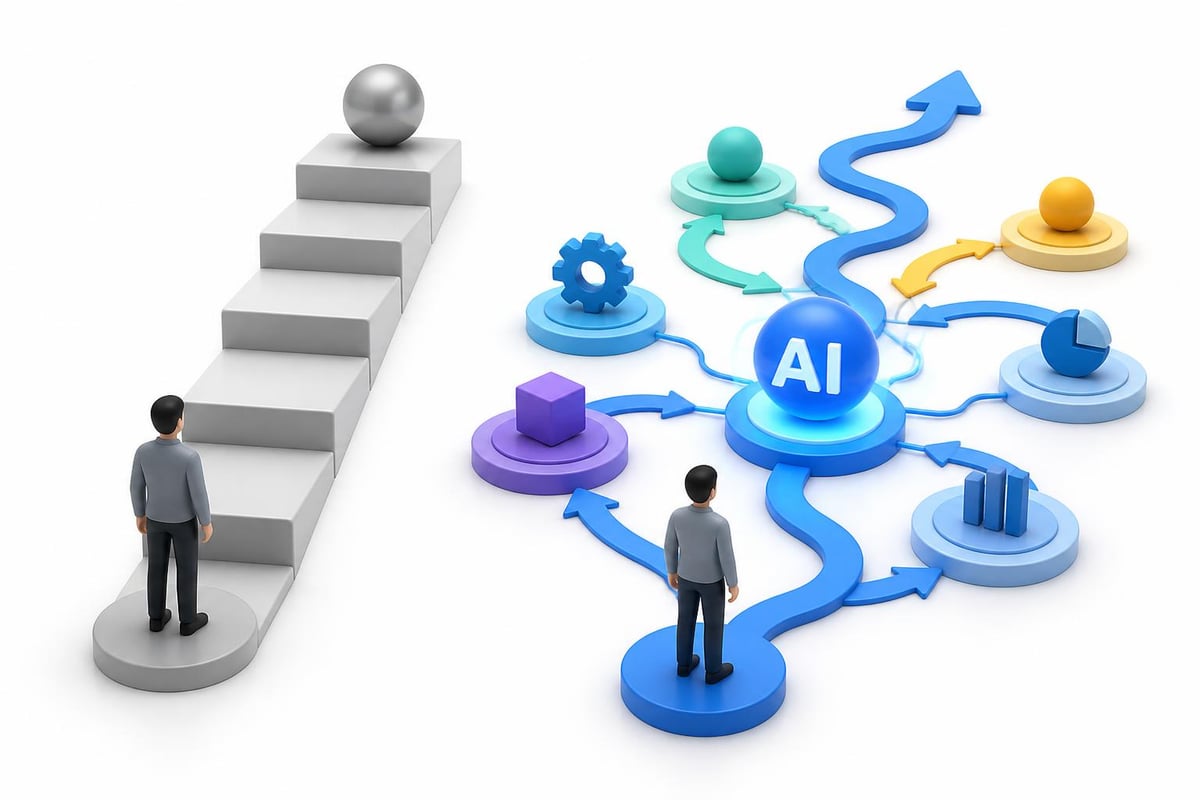
The playbook that worked for previous generations has lost its effectiveness. A four-year degree followed by incremental promotions within a single company represents an increasingly rare trajectory. Research on blended work environments reveals that human roles are rapidly evolving to integrate with AI systems, fundamentally changing what "expertise" means in any given field.
Career today demands continuous skill evolution rather than one-time credential acquisition. Professionals who treat learning as an ongoing discipline rather than a phase of life consistently outperform peers with superior initial credentials but stagnant skill sets.
High-Demand AI Skills Reshaping Career Opportunities
The specific capabilities that employers value most have shifted dramatically. Understanding these priority areas helps you invest learning time strategically rather than pursuing credentials with diminishing returns.
Technical Skills with Immediate Market Value
| Skill Category | Application Examples | Salary Impact |
|---|---|---|
| Prompt Engineering | Content generation, customer service automation, research assistance | 15-30% increase |
| ML Model Integration | API connections, workflow automation, predictive analytics | 25-45% increase |
| AI Tool Mastery | Platform-specific expertise (ChatGPT, Claude, Midjourney, etc.) | 10-25% increase |
| Data Pipeline Management | Training data preparation, quality control, bias detection | 30-50% increase |
These aren't theoretical concepts reserved for data scientists. Marketing professionals use prompt engineering daily. Project managers automate status reporting through AI integrations. Sales teams leverage predictive analytics to prioritize leads.
Your career today benefits most from applied AI knowledge rather than purely theoretical understanding. Employers care less about your ability to explain transformer architecture and more about whether you can reduce a manual process from three hours to fifteen minutes using appropriate tools.
Soft Skills Amplified by AI Context
Technical proficiency alone won't differentiate your career today from thousands of other candidates with similar certifications. The professionals commanding premium compensation combine AI expertise with enhanced human capabilities:
- Critical evaluation of AI outputs for accuracy and appropriateness
- Creative direction that guides AI tools toward novel solutions
- Ethical judgment balancing efficiency with responsibility
- Strategic thinking identifying high-impact automation opportunities
- Change management helping teams adopt AI-enhanced workflows
These competencies make you indispensable rather than replaceable. As automation potential research demonstrates, roles requiring nuanced judgment and contextual decision-making face minimal displacement risk compared to purely procedural positions.
Building Your AI Career Foundation Strategically
Generic advice to "learn AI" leaves most people overwhelmed by endless course options and conflicting recommendations. A targeted approach produces faster results with less wasted effort.
Start with Role-Specific AI Applications
Rather than beginning with programming languages or theoretical frameworks, identify how AI already enhances your target role. A content strategist benefits more from mastering SEO automation tools than from learning Python. A financial analyst gains immediate value from AI-powered forecasting platforms before diving into model training.
For professionals ready to accelerate their transition into AI roles, structured training programs provide the most efficient path forward. The Mammoth Club AI Certification Program offers hands-on training in real-world AI workflows, automation techniques, and the specific tools employers actually use, helping you build demonstrable skills that translate directly to job opportunities and higher income.

Your career today advances fastest when you can demonstrate concrete AI achievements in current responsibilities, even before officially transitioning into dedicated AI positions.
Create a Portfolio of AI-Enhanced Projects
Certificates matter less than proof of applied capability. Hiring managers for your career today want evidence you've solved real problems using AI tools:
- Document automation workflows you've implemented
- Share before/after metrics showing efficiency gains
- Publish case studies of AI integration challenges you overcame
- Build demonstration projects showcasing your technical range
- Contribute to AI discussions establishing thought leadership
These artifacts differentiate you from candidates who merely list courses completed. They provide concrete talking points for interviews and justify premium compensation requests.

Navigating Career Transitions into AI Roles
The most common question professionals ask about their career today is whether they need to start completely over to enter AI fields. The answer is almost always no. Your existing expertise becomes more valuable when combined with AI capabilities.
Leverage Your Domain Expertise
Organizations struggle to find professionals who understand both AI technology and specific industry contexts. A healthcare administrator with AI automation skills is exponentially more valuable than a pure technologist without medical workflow knowledge. The same applies across:
- Legal professionals implementing contract analysis automation
- Manufacturing specialists optimizing production through predictive maintenance
- Marketing veterans deploying personalization engines
- HR leaders streamlining recruitment with intelligent screening
Your career today benefits from positioning yourself at the intersection of your current expertise and emerging AI applications within that domain. This strategy faces far less competition than attempting to out-credential computer science graduates.
Identify Transition Roles That Bridge Experience
Direct jumps from non-technical roles into machine learning engineer positions rarely succeed. Smart career today strategies involve intermediate steps that build credibility progressively:
- AI implementation specialist in your current field
- Automation consultant for familiar business processes
- AI project coordinator bridging technical and business teams
- Data analyst with AI tool specialization
- AI trainer teaching tools to domain experts
These positions allow you to apply AI knowledge while leveraging existing professional networks and industry understanding. They also provide practical experience that makes subsequent moves to pure AI roles far more achievable.
Staying Competitive as AI Evolves
Your career today exists in unprecedented flux. Tools that didn't exist six months ago now define entire job categories. Strategies for maintaining relevance require intentional systems rather than reactive scrambling.
Build Continuous Learning Habits
Rather than periodic intensive learning bursts, successful AI professionals embed skill development into daily routines:
- Dedicate 30 minutes daily to exploring new AI tools or techniques
- Follow 5-10 AI practitioners who share practical applications
- Participate in online communities discussing real implementation challenges
- Experiment with new platforms as they emerge, even briefly
- Document your learning to reinforce retention and build portfolio content
According to Microsoft Research’s Future of Work Report, professionals who integrate AI learning into regular workflows rather than treating it as separate training show 3x faster skill acquisition and better retention.
Monitor Emerging Role Categories
Your career today might evolve into positions that don't yet have formal job titles. Watching emerging trends helps you position yourself ahead of competition:
| Emerging Role | Primary Focus | Growth Trajectory |
|---|---|---|
| Prompt Architect | Designing optimal AI interactions for specific outcomes | 200%+ annual growth |
| AI Ethics Coordinator | Ensuring responsible AI deployment and bias mitigation | 150% annual growth |
| Automation Strategist | Identifying and prioritizing AI implementation opportunities | 180% annual growth |
| AI Training Specialist | Teaching teams to effectively use AI tools | 165% annual growth |
Positioning your career today toward these emerging categories provides first-mover advantages before markets become saturated. Early specialists in new fields command premium compensation and choice of opportunities.
Income Acceleration Through AI Mastery
The financial impact of AI expertise extends beyond salary premiums. Your career today can leverage AI capabilities for multiple income streams and accelerated advancement.
Quantify Your AI Impact
Compensation negotiations succeed when you present concrete value delivered. AI applications provide clear metrics:
- Time savings converted to cost reduction
- Revenue increases from AI-enhanced processes
- Error reduction in automated workflows
- Capacity expansion without proportional headcount
- Customer satisfaction improvements through AI personalization
Professionals who track and articulate these metrics see 25-40% higher compensation than peers with similar AI skills but vague value propositions. Your career today benefits enormously from treating each AI implementation as a documented case study for future negotiations.
Create Scalable Income Opportunities
AI expertise enables income diversification beyond traditional employment. Forbes analysis of 2025 work trends shows that professionals with AI skills increasingly pursue portfolio careers combining multiple income sources:
- Consulting engagements implementing AI for smaller organizations
- Online course creation teaching specific AI applications
- Freelance automation projects for businesses lacking internal expertise
- AI tool affiliate partnerships recommending solutions you actually use
- Paid content creation analyzing AI trends and applications
These additional streams often start small but grow substantially as your reputation develops. They also provide security against the employment uncertainty that defines your career today.

Addressing Common Career Today Challenges
Despite the opportunities, professionals face legitimate obstacles when building AI careers. Understanding these challenges helps you navigate them strategically rather than becoming discouraged.
Overcoming Imposter Syndrome in Fast-Moving Fields
The rapid pace of AI development means everyone, including experts, regularly encounters unfamiliar concepts. Your career today doesn't require knowing everything, just being comfortable with continuous learning and honest about current capabilities versus development areas.
Successful AI professionals focus on depth in specific applications rather than surface-level familiarity with everything. Choose 2-3 tools or techniques, develop genuine expertise, then gradually expand your range. This approach builds legitimate confidence while avoiding the paralysis of trying to master every emerging technology simultaneously.
Balancing Current Responsibilities with Skill Development
Career advancement while maintaining job performance creates real time constraints. Effective strategies include:
- Propose AI pilots within current role, turning work into learning
- Volunteer for AI-related projects gaining experience through existing responsibilities
- Replace low-value activities with AI automation, freeing time for skill development
- Schedule learning time as non-negotiable appointments rather than fitting it around everything else
The professionals advancing their career today most effectively treat skill development as essential work rather than optional enhancement. This mindset shift fundamentally changes prioritization decisions.
Finding the Right Learning Resources
The explosion of AI training creates analysis paralysis. Workplace transformation research reveals that learning effectiveness depends more on application opportunities than content quality. Choose programs offering:
- Practical projects using actual business scenarios
- Tool-specific training rather than purely theoretical concepts
- Community access for troubleshooting and motivation
- Certification credentials recognized by employers
- Update cycles keeping content current with tool evolution
Resources emphasizing conceptual understanding over hands-on application rarely translate to career advancement. Your career today needs demonstrable capabilities, not theoretical knowledge.
The Long-Term Career Today Perspective
While immediate skill acquisition matters, sustainable AI careers require strategic thinking beyond next year's opportunities. The professionals thriving a decade from now make different choices than those optimizing for immediate gains.
Build Transferable AI Foundations
Specific tools will become obsolete. The ability to quickly master new tools remains valuable indefinitely. Your career today should develop:
- Core understanding of how AI models function at a conceptual level
- Problem decomposition skills breaking complex challenges into AI-solvable components
- Evaluation frameworks assessing AI outputs for quality and appropriateness
- Integration thinking connecting AI capabilities to broader systems
- Learning methodology allowing rapid tool acquisition as technology evolves
These foundational capabilities protect your career today against the inevitable obsolescence of specific platforms while positioning you to capitalize on emerging technologies before competitors.
Cultivate Human-AI Collaboration Mindset
Research on AGI economic integration suggests that the most valuable professionals won't be those who can do what AI does, but rather those who excel at directing AI systems toward optimal outcomes while handling the judgment calls AI can't make.
Your career today should emphasize complementary capabilities rather than competing with automation. Focus on areas where human insight adds irreplaceable value: strategic direction, ethical oversight, creative innovation, and contextual judgment.
Taking Action on Your Career Today
Understanding AI's impact on careers means nothing without implementation. The gap between professionals who thrive and those who struggle isn't knowledge, it's execution.
Start with one concrete action this week. Not a vague commitment to "learn AI," but a specific achievable step:
- Identify one manual task in your current role suitable for AI automation
- Complete one project using an AI tool you haven't tried before
- Reach out to one person working in an AI role you find interesting
- Apply to one position slightly beyond your current AI capabilities
- Document one AI achievement for your portfolio
Your career today transforms through accumulated small actions, not grand gestures. Consistency matters more than intensity.
The professionals commanding six-figure AI salaries in 2026 didn't wait for perfect preparation. They started learning, applying, and iterating while others debated whether the investment was worthwhile. The difference between a thriving career today and five years of frustration often comes down to starting now rather than later.
Your career today presents unprecedented opportunities for those willing to develop AI capabilities strategically. The combination of high employer demand, accessible learning resources, and clear paths to high-paying roles creates conditions rarely seen in professional markets. Whether you're starting fresh, pivoting from another field, or advancing existing AI knowledge, the next steps you take will determine your trajectory in an AI-driven economy. AI Career Central provides the step-by-step guidance, practical training, and certification support you need to build demonstrable AI skills that translate directly into job offers, promotions, and income growth.