
The landscape of professional education has fundamentally shifted in 2026, and the traditional career degree is no longer the only pathway to success. While millions still pursue conventional four-year programs, a growing number of professionals are discovering that specialized, career-focused education delivers faster results, higher salaries, and better job market alignment. The question isn't whether you need credentials, but rather which type of career degree will position you for the high-paying opportunities emerging in artificial intelligence, automation, and advanced technology roles. Understanding your options and making strategic choices about your education can mean the difference between launching a thriving career and struggling to find relevance in an AI-driven economy.
Understanding Modern Career Degree Options
The term "career degree" encompasses far more than traditional bachelor's and master's programs. In 2026, career-focused education includes specialized certifications, micro-credentials, industry-recognized training programs, and hybrid learning pathways that combine academic knowledge with practical skills.
Traditional degrees still hold value, particularly from accredited institutions. According to Walden University’s research, bachelor's degree holders earn significantly more over their lifetimes compared to those with only high school diplomas. However, the curriculum often lags behind industry needs, especially in fast-moving fields like AI.

The Value Proposition of Different Educational Paths
When evaluating any career degree program, consider these critical factors:
- Time to completion: Traditional degrees require 2-4 years, while specialized programs can be completed in 3-12 months
- Cost investment: Student loan debt versus affordable, pay-as-you-go training options
- Curriculum relevance: Theoretical knowledge versus hands-on, job-ready skills
- Employer recognition: Which credentials actually open doors in your target industry
- Income acceleration: How quickly you can start earning or increase your current salary
The differences between online and traditional degrees have narrowed significantly. Employers now view quality online programs as equivalent to in-person education, especially when they emphasize practical application and industry-standard tools.
Career-Focused Education vs. Traditional Academic Programs
The fundamental distinction between a career degree and a traditional academic degree lies in purpose and design. Career-focused degree programs prioritize immediate job market applicability, teaching students the specific skills employers are actively seeking right now.
Traditional academic programs emphasize broad theoretical knowledge and critical thinking. They're excellent for research, academia, and fields where foundational understanding matters more than technical execution. But in rapidly evolving industries like artificial intelligence, this approach creates a dangerous gap between graduation and employability.
Why AI Careers Demand Different Credentials
The AI job market operates differently than traditional industries. Employers hiring for machine learning engineers, prompt engineers, AI automation specialists, and data scientists care more about demonstrated capability than educational pedigree.
| Traditional Degree Strength | AI-Focused Career Credential Strength |
|---|---|
| Broad theoretical foundation | Specific, job-ready technical skills |
| University brand recognition | Portfolio of real-world projects |
| General problem-solving ability | Proficiency in current AI tools and platforms |
| 4+ years of comprehensive study | 3-12 months of intensive, targeted training |
| Academic research experience | Industry-standard workflow experience |
This isn't to suggest traditional degrees have no place. Graduate degrees from institutions like UCLA provide advanced specialization, networking opportunities, and research credentials valuable for certain career trajectories. But for most people looking to enter or advance in AI careers, specialized training delivers better ROI.
Choosing the Right Career Degree for AI Success
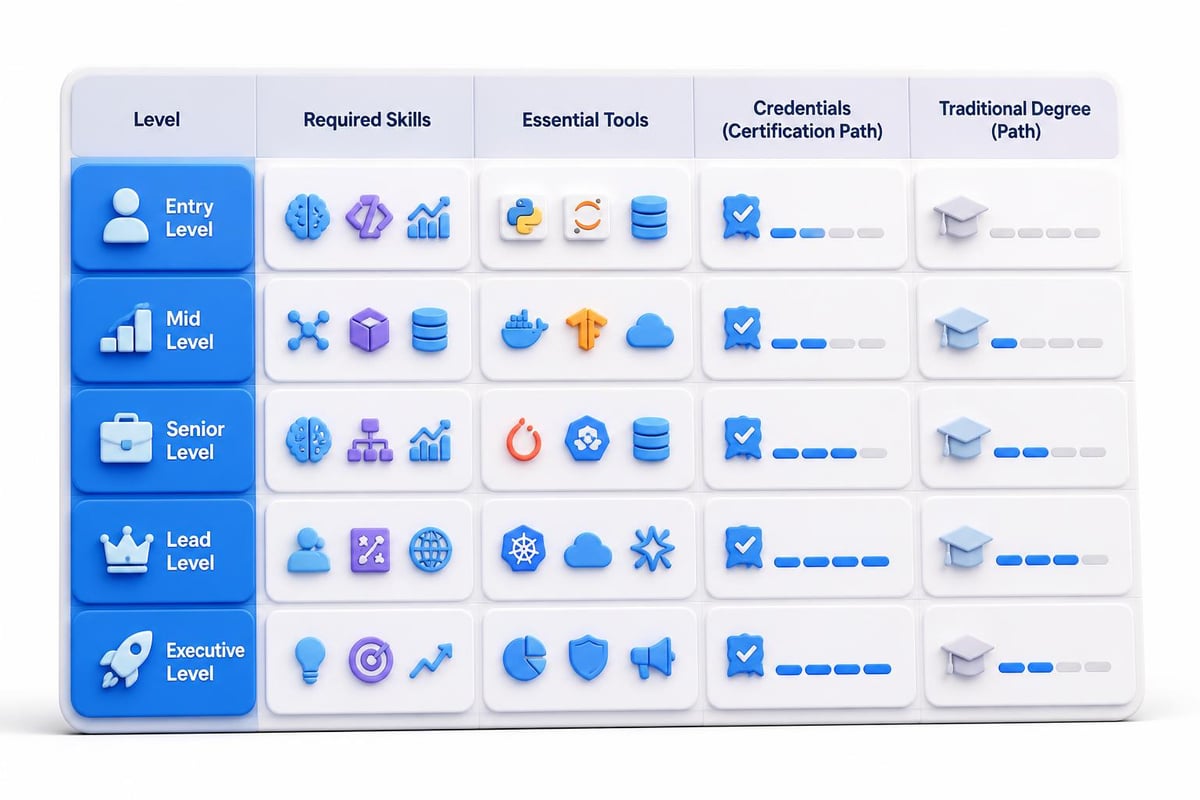
Your educational path should align with three critical factors: your current situation, your target role, and the specific skills employers demand in 2026. The artificial intelligence field encompasses diverse specializations, each requiring different knowledge and capabilities.
Entry-level AI roles like AI support specialists, prompt engineers, and automation coordinators typically require demonstrated proficiency with specific tools rather than formal degrees. Building a strong portfolio through project-based learning often outweighs academic credentials.
Mid-level positions such as machine learning engineers, AI product managers, and data scientists benefit from structured training that covers both technical skills and business application. This is where comprehensive certification programs prove invaluable.
Evaluating Program Quality and Career Outcomes
Not all career degree programs deliver equal results. Before investing time and money, investigate these key indicators:
- Employment statistics: What percentage of graduates land jobs within 90 days?
- Salary outcomes: Do graduates achieve meaningful income increases?
- Curriculum currency: Does the program teach tools and techniques used in 2026 workplaces?
- Industry partnerships: Do real companies recognize and value this credential?
- Hands-on projects: Will you build a portfolio that demonstrates capability?
Many professionals waste years pursuing credentials that look impressive but don't translate to job offers. The most effective approach combines strategic education with practical skill development. Programs that emphasize real-world AI workflows, automation implementation, and modern tools deliver better career outcomes than purely theoretical study.
For those serious about building AI expertise efficiently, AI Certification Program – Mammoth Club provides structured training designed around actual job requirements. You'll learn practical AI workflows, automation techniques, and in-demand tools through guided projects that directly translate to employment opportunities.

Building Competitive Advantage Through Specialized Learning
The comparison between microlearning and traditional degrees reveals important insights for career advancement. While comprehensive degrees provide broad knowledge, microlearning and specialized certifications allow rapid skill acquisition in high-demand areas.
In the AI field, this distinction becomes critical. Technology evolves faster than universities can update curricula. A machine learning framework popular when you start a four-year degree might be obsolete before graduation. Specialized training programs update continuously, keeping pace with industry changes.
The Strategic Approach to Skill Development
Successful AI professionals in 2026 follow a strategic pattern: they build foundational knowledge through focused study, then continuously expand capabilities through project-based learning and targeted certifications.
Essential AI skills worth investing in:
- Prompt engineering and large language model interaction
- Automation workflow design and implementation
- Data analysis and visualization tools
- Machine learning model deployment and monitoring
- AI ethics and responsible implementation
- Cloud platform proficiency (AWS, Azure, Google Cloud)
Rather than pursuing a generalized career degree, high earners focus intensively on skills directly tied to compensation. They understand which technical capabilities command premium salaries and invest their learning time accordingly. This targeted approach reduces time to employment and accelerates income growth.
Maximizing ROI on Your Educational Investment
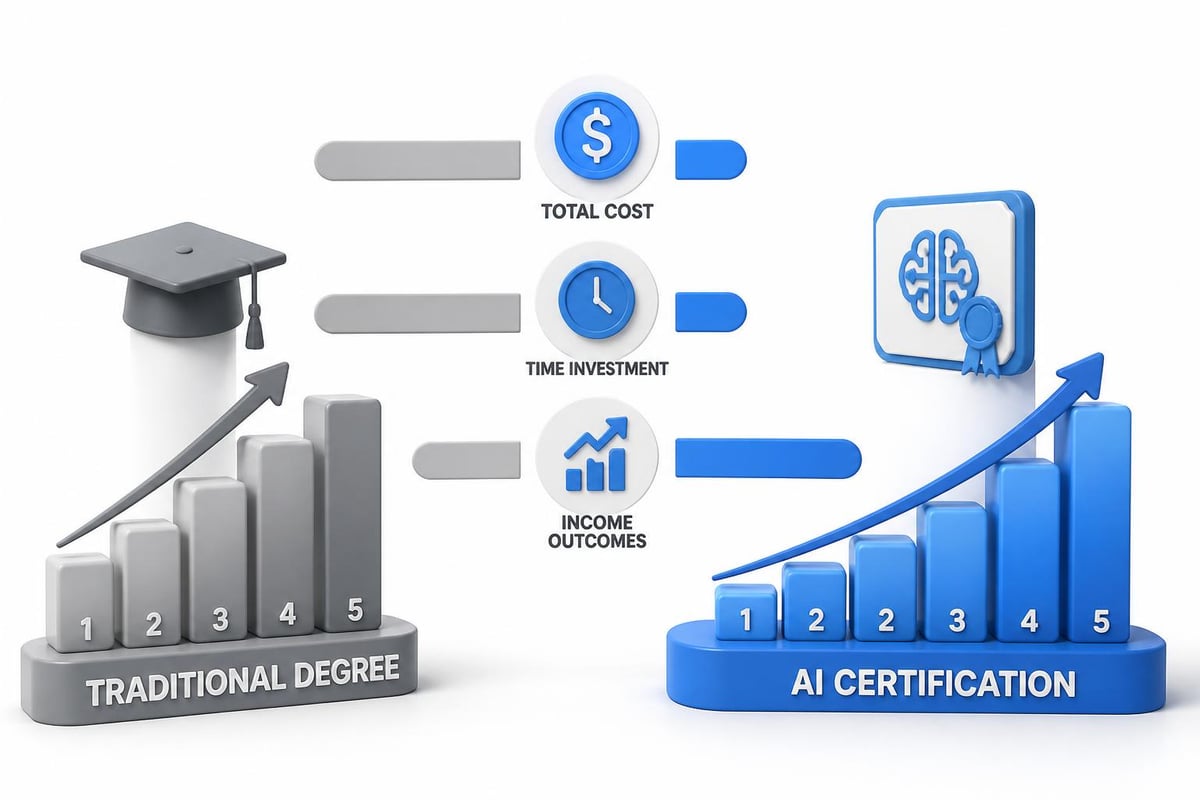
The return on investment for any career degree should be measured in concrete outcomes: job placement, salary increase, and career advancement speed. In 2026, the most successful professionals treat education as strategic investment rather than an end goal.
Calculate your educational ROI using this framework:
- Total cost (tuition, fees, opportunity cost of lost income)
- Time investment (months from start to employment)
- Salary differential (new income vs. current income)
- Career trajectory (advancement opportunities created)
- Skill durability (how long these capabilities remain valuable)
Traditional four-year degrees often require $50,000-$200,000 in investment plus four years of opportunity cost. Specialized AI training programs typically cost $5,000-$15,000 and can be completed while working, dramatically improving the financial equation.
Balancing Credentials and Practical Experience
The most valuable career degree combines recognized credentials with demonstrable skills. Employers hiring for highest-paying AI jobs want proof you can deliver results, not just theoretical knowledge.
Your educational path should produce three critical assets:
- Recognized certification that establishes baseline credibility
- Project portfolio demonstrating real-world application
- Professional network connecting you to opportunities and mentors
This combination opens doors traditional degrees alone cannot. When you can show a hiring manager actual AI automation workflows you've built, data models you've deployed, or business problems you've solved through machine learning, your career degree transforms from a checkbox item into a powerful competitive advantage.
Navigating the Changing Landscape of Professional Credentials
The value of online degrees has increased substantially as remote work normalizes. In 2026, the delivery method matters far less than program quality and career outcomes. Top employers now actively recruit from online programs that emphasize practical skills and industry alignment.
This shift creates unprecedented opportunities for career changers and professionals seeking advancement. You no longer need to quit your job, relocate, or spend four years in classrooms to build competitive AI skills. The barrier to entry has dropped, but the requirement for strategic learning has intensified.
Making the Career Degree Decision
Choosing the right educational path requires honest assessment of your situation and goals. Consider these decision factors:
| Your Situation | Best Career Degree Approach |
|---|---|
| Entry-level, no tech background | Specialized AI certification focusing on practical tools |
| Switching from another industry | Intensive bootcamp or comprehensive training program |
| Current tech role, seeking AI skills | Targeted micro-credentials in specific AI applications |
| Experienced professional seeking advancement | Advanced certifications or focused graduate programs |
| Building long-term AI expertise | Combination of certifications, projects, and continuous learning |
The difference between interdisciplinary and traditional degrees becomes particularly relevant in AI careers. Many successful AI professionals combine technical skills with domain expertise in healthcare, finance, marketing, or other industries, creating unique value propositions.
Taking Action on Your Career Degree Path
Information without action produces no results. The right career degree for your situation exists, but only you can take the first step toward earning it. In 2026's competitive job market, waiting means falling further behind as AI adoption accelerates across industries.
Your immediate action plan:
- Identify your target AI role and required skills
- Research programs based on employment outcomes, not marketing claims
- Verify employer recognition of specific credentials in your target industry
- Assess your learning style and available time commitment
- Start with one focused program rather than delaying for the "perfect" option
The professionals advancing fastest in AI careers share one characteristic: they prioritize practical skill development over credential collection. They understand that a career degree should serve as a launchpad, not a destination. They complete targeted training, immediately apply new skills to real projects, and continuously expand their capabilities based on market demand.
Those searching for careers with no experience needed often discover AI offers accessible entry points, but only for those willing to invest in strategic learning. Entry-level positions exist, but they require demonstrated capability with specific tools and workflows that career-focused programs teach.
Similarly, professionals exploring computer science degree job opportunities find that traditional degrees open doors, but specialized AI credentials often lead to higher starting salaries and faster advancement, particularly in highest-paying IT careers.
Staying Competitive Through Continuous Learning
A career degree in 2026 isn't a one-time achievement. The half-life of technical skills continues shrinking as AI capabilities expand. What you learn today may need updates or supplements within 12-18 months. This reality demands a shift from "completing education" to "maintaining expertise."
The professionals commanding top salaries treat learning as an ongoing investment. They allocate time weekly to explore new AI tools, experiment with emerging techniques, and expand their practical capabilities. This continuous development approach compounds over time, creating substantial competitive advantages.
Building Your Learning System
Effective continuous learning requires structure. Random exploration produces random results. Strategic skill development follows a clear pattern:
- Monitor industry trends to identify emerging high-value skills before they become saturated
- Prioritize hands-on practice over passive consumption of educational content
- Build public projects that demonstrate growing capabilities
- Engage with professional communities to accelerate knowledge sharing
- Measure results by tracking job opportunities, interview requests, and salary negotiations
This systematic approach to career development amplifies the value of your initial career degree. Each new skill builds on previous knowledge, creating an expanding portfolio of capabilities that employers recognize and compensate accordingly.
The right career degree accelerates your path to high-paying AI roles, but success requires strategic choices about which credentials to pursue and how to apply them. Whether you choose traditional academic programs, specialized certifications, or hybrid approaches, focus on programs that deliver practical skills, recognized credentials, and measurable career outcomes. AI Career Central provides the step-by-step guidance, practical training, and career path clarity you need to make confident decisions about your AI education and land competitive positions faster in 2026's evolving job market.