
The artificial intelligence job market has transformed dramatically, creating unprecedented opportunities for professionals seeking the highest career advancement and compensation in tech. As organizations race to integrate AI into their operations, they're willing to pay premium salaries for talent who can design, implement, and optimize intelligent systems. Understanding which AI roles offer the greatest earning potential and career trajectory can help you make strategic decisions about your professional development and position yourself for long-term success in this rapidly evolving field.
Understanding the Highest Career Opportunities in AI
The AI job market isn't just growing; it's exploding with specialized roles that command exceptional compensation packages. Machine learning engineers, AI research scientists, and computer vision specialists consistently rank among the highest-paid technology professionals, with total compensation packages frequently exceeding $200,000 annually for experienced practitioners.
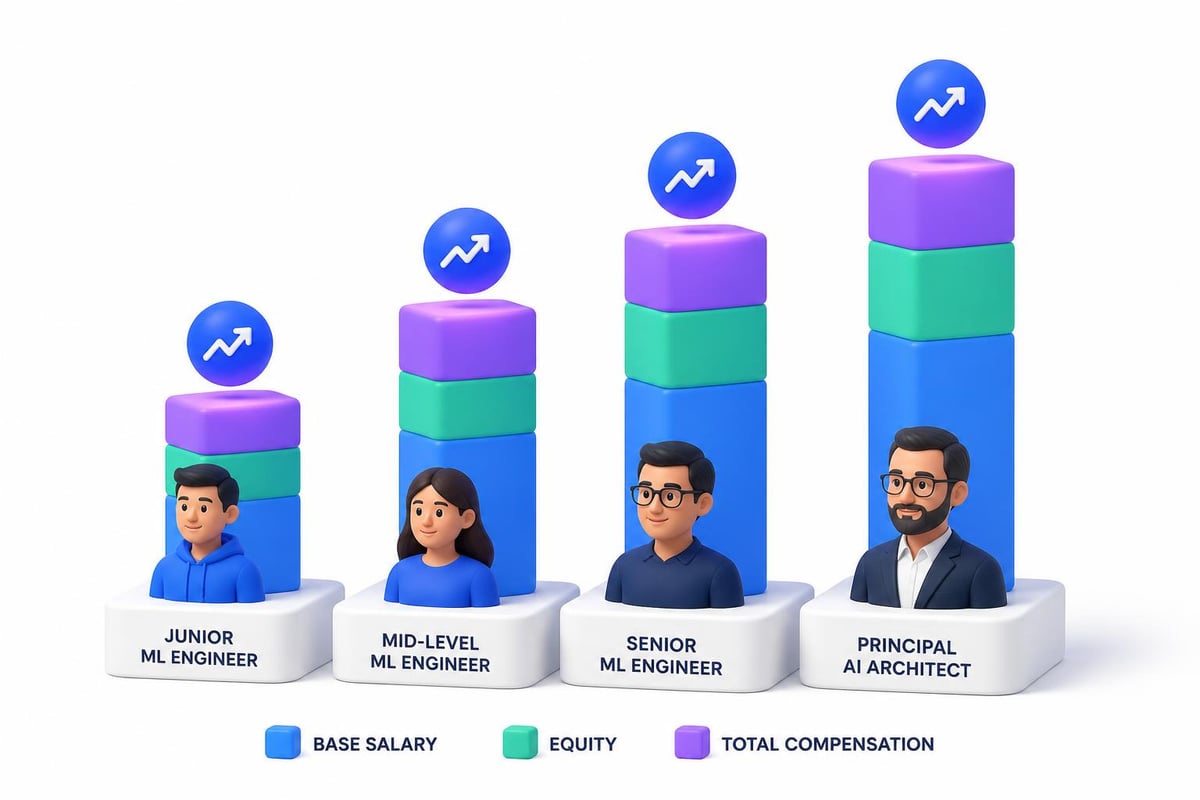
What sets these roles apart isn't just the base salary. The comprehensive compensation packages in AI roles often include substantial equity, performance bonuses, and non-monetary benefits that significantly enhance total value. Companies recognize that AI talent drives competitive advantage, and they structure compensation accordingly.
Defining Your Highest Career Target
Before diving into specific roles, you need clarity on what "highest career" means for your unique situation. For some professionals, it's purely about maximizing income within five years. For others, it's balancing compensation with intellectual challenge, work-life integration, or mission-driven impact.
The most successful AI career transitions happen when you align your goals with market realities:
- Income maximization: Targeting roles in fintech, autonomous vehicles, or enterprise AI
- Rapid advancement: Focusing on high-growth startups where equity can multiply your wealth
- Skill development: Prioritizing positions that expose you to cutting-edge research and tools
- Industry impact: Choosing sectors like healthcare AI or climate technology where your work creates measurable change
Your pathway to the highest career in AI starts with honest self-assessment and market research.
Top-Paying AI Roles Driving Career Growth
The highest-paying positions in technology increasingly concentrate in artificial intelligence and machine learning domains. These roles demand specialized expertise but offer compensation that justifies the investment in skill development.
| Role | Average Total Comp | Key Requirements | Growth Trajectory |
|---|---|---|---|
| AI Research Scientist | $185K-$350K | PhD, published research, advanced ML | Exceptional |
| Machine Learning Engineer | $145K-$280K | Strong coding, ML frameworks, deployment | Very High |
| Computer Vision Engineer | $140K-$265K | Deep learning, image processing, optimization | High |
| NLP Engineer | $135K-$255K | Transformers, LLMs, linguistics background | Very High |
| AI Product Manager | $150K-$290K | Technical background, product strategy | High |
Machine learning engineers represent the sweet spot for many professionals pursuing the highest career trajectory. These roles combine software engineering fundamentals with statistical modeling and business impact. You're building production systems that process millions of transactions, recommend products, detect fraud, or power autonomous systems.
The demand for ML engineers has grown 344% since 2019, and this trend shows no signs of slowing. Companies need practitioners who can translate research papers into scalable code, optimize model performance, and collaborate across teams to deliver business value.
Specialized AI Domains with Premium Compensation
Beyond generalist ML roles, specialized domains command even higher premiums. Autonomous vehicle engineers, for instance, work on perception systems, path planning, and sensor fusion. The technical complexity and safety-critical nature of this work pushes compensation into the $200K-$400K range for senior practitioners.
Similarly, AI security specialists who protect machine learning systems from adversarial attacks or ensure model fairness earn substantial premiums. As AI systems become targets for sophisticated attacks, companies desperately need experts who understand both AI and cybersecurity.
The geospatial AI field represents another high-growth area where Geographic Information Systems merge with machine learning. Professionals who can analyze satellite imagery, predict environmental changes, or optimize logistics using spatial data command impressive salaries across government, agriculture, and urban planning sectors.
Building Your Pathway to the Highest Career
Achieving the highest career outcomes in AI requires more than technical skills. You need a strategic roadmap that addresses skill gaps, builds credibility, and positions you for premium opportunities.
Essential Technical Foundations
Your technical foundation determines which doors open. Start with these core competencies:
- Programming proficiency: Python remains the lingua franca of AI, with PyTorch and TensorFlow as essential frameworks
- Mathematical foundations: Linear algebra, calculus, probability, and statistics underpin every AI algorithm
- Data engineering: Understanding data pipelines, databases, and ETL processes separates hobbyists from professionals
- Cloud platforms: AWS, Google Cloud, or Azure experience for deploying models at scale
- Version control and MLOps: Git, Docker, Kubernetes, and experiment tracking tools
Many professionals struggle with the gap between online courses and production-ready skills. The difference lies in practical application. Building end-to-end projects where you source data, engineer features, train models, optimize performance, and deploy to production teaches you the messy reality of AI work.
Accelerating Your Journey with Structured Training
While self-study works for highly disciplined individuals, structured programs dramatically accelerate skill acquisition. The Mammoth Club AI Certification Program provides guided learning paths that take you from fundamentals to career-ready competency. You'll work through real-world AI workflows, master automation techniques, and build a portfolio that demonstrates practical skills to potential employers.

Certifications serve multiple purposes in your highest career strategy. They validate your knowledge to skeptical hiring managers, fill specific skill gaps, and demonstrate commitment to professional development. More importantly, quality certification programs teach you the tools and workflows that companies actually use, not just academic concepts.

Positioning Yourself for Premium Opportunities
Technical skills get you in the door, but positioning determines which doors you access. The highest career opportunities go to professionals who understand market dynamics and personal branding.
Building a Compelling Portfolio
Your portfolio proves you can deliver results. Instead of toy datasets, tackle problems that demonstrate business acumen:
- Predictive maintenance model that reduces equipment downtime by 30%
- Customer churn prediction system with actionable insights for retention
- Content recommendation engine that increases user engagement metrics
- Computer vision application that automates manual inspection processes
Each project should tell a story: the business problem, your approach, technical challenges overcome, and measurable impact. Host your work on GitHub with clear documentation, and write blog posts explaining your methodology.
Strategic Networking in AI Communities
The highest-paying opportunities rarely appear on job boards. They're filled through referrals, conference connections, and community engagement. Invest time in:
- Contributing to open-source AI projects where practitioners from target companies collaborate
- Attending AI meetups, conferences, and workshops in your target metro area
- Engaging meaningfully on platforms where AI leaders share insights
- Publishing technical content that demonstrates expertise and thought leadership
One quality connection with a hiring manager or team lead is worth fifty cold applications. Focus on providing value first, asking thoughtful questions, and building genuine relationships.
Maximizing Compensation in Your AI Career
Understanding compensation structures helps you negotiate effectively and choose the right opportunities. The highest career earnings in AI come from strategic thinking about total compensation, not just base salary.
Components of AI Compensation Packages
| Component | Typical Range | Negotiation Potential |
|---|---|---|
| Base Salary | 60-75% of total comp | Moderate |
| Annual Bonus | 10-20% of base | Moderate to High |
| Equity/RSUs | 15-30% of total comp | High |
| Sign-On Bonus | $10K-$100K+ | High |
| Benefits & Perks | $15K-$40K value | Low |
Equity compensation deserves special attention. In high-growth companies, your stock grants might ultimately exceed your salary multiple times over. Understanding vesting schedules, strike prices, and valuation helps you evaluate offers accurately.
When negotiating, focus on total compensation over four years, not just year-one cash. A company offering $150K base with $200K in equity vesting over four years provides substantially more value than one offering $170K base with minimal equity.
Timing Your Career Moves Strategically
The timing of career transitions significantly impacts your trajectory toward the highest career outcomes. Moving too frequently prevents you from developing deep expertise and building a track record of impact. Staying too long in roles with limited growth potential caps your earning potential.
Consider these strategic timing principles:
- Stay at least 18-24 months to demonstrate sustained impact and complete meaningful projects
- Time transitions to coincide with equity vesting schedules when possible
- Pursue external opportunities when internal promotion timelines extend beyond 2-3 years
- Leverage competing offers to negotiate aggressive raises at your current company
Each career move should represent a meaningful step up in compensation, responsibility, or skill development. Lateral moves occasionally make sense for entering hot sectors or joining high-trajectory companies, but they should be exceptions.
Emerging AI Specializations for Career Growth
The AI field continuously evolves, creating new specializations that command premium compensation. Positioning yourself at the intersection of emerging technologies and proven business value accelerates your path to the highest career outcomes.
Prompt Engineering and LLM Optimization
The explosion of large language models has created entirely new roles. Prompt engineers who optimize AI interactions for specific business applications earn $125K-$200K with less formal training than traditional ML roles. This represents an accessible entry point for career changers.
More advanced LLM fine-tuning specialists who adapt foundation models for enterprise use cases command even higher premiums. As companies realize that off-the-shelf ChatGPT won't solve their unique problems, demand for professionals who can customize and deploy specialized language models skyrockets.
AI Ethics and Governance
As AI systems make consequential decisions about hiring, lending, and criminal justice, companies need specialists who ensure fairness, transparency, and compliance. AI ethics officers and responsible AI engineers represent a growing specialty at the intersection of technical knowledge, ethics, and regulatory compliance.
These roles typically require both technical AI understanding and background in law, philosophy, or social sciences. Compensation ranges from $140K-$250K depending on seniority and industry.
Multimodal AI Systems
The frontier of AI research involves systems that seamlessly integrate text, images, audio, and video. Engineers building multimodal AI applications work on problems like video understanding, document intelligence, and cross-modal retrieval. The complexity of these systems and their broad applicability justify premium compensation.
This specialization requires deep understanding of multiple AI domains: computer vision, natural language processing, and speech recognition. It's challenging but positions you for the highest career trajectory as these systems become central to how we interact with technology.
Transitioning from Adjacent Fields into AI
You don't need a computer science PhD to access the highest career opportunities in AI. Professionals from software engineering, data science, statistics, and even domain expertise in finance or biology successfully transition into premium AI roles.
Leverage Your Existing Expertise
Your domain knowledge represents competitive advantage. A pharmaceutical researcher who learns machine learning can build drug discovery models that pure technologists struggle to design. A financial analyst who develops deep learning skills can create trading strategies or risk models that combine market intuition with technical execution.
The most valuable AI professionals understand both the technology and the problem domain deeply. Learn more about transitioning into AI careers regardless of your current background.
Fill Strategic Skill Gaps Efficiently
Rather than trying to match the credentials of traditional AI researchers, focus on high-leverage skills that unlock opportunities:
- Master one deep learning framework (PyTorch or TensorFlow) thoroughly
- Build three portfolio projects that demonstrate end-to-end capability
- Understand deployment and MLOps fundamentals
- Develop communication skills to explain technical concepts to business stakeholders
This focused approach gets you into your first AI role 12-18 months faster than pursuing a graduate degree. Once employed, you continue learning on the job while earning strong compensation.

Sustaining Career Growth in a Rapidly Evolving Field
Achieving the highest career in AI isn't a one-time accomplishment. The field evolves so rapidly that yesterday's cutting-edge techniques become commoditized within months. Sustained success requires continuous learning and strategic adaptation.
Building a Personal Learning System
Successful AI professionals dedicate 5-10 hours weekly to skill development. This isn't random browsing; it's systematic learning focused on emerging tools and techniques that create competitive advantage.
Structure your learning around:
- Following key AI research labs and reading selective papers monthly
- Experimenting with new frameworks and tools as they gain traction
- Building side projects that explore emerging capabilities
- Teaching others what you learn to deepen your understanding
The professionals commanding the highest career compensation aren't necessarily the smartest; they're the ones who continuously adapt and apply new knowledge to create business value.
Expanding Beyond Pure Technical Skills
As you advance into senior roles, technical execution becomes table stakes. Leadership, communication, and business strategy separate good engineers from those who reach principal engineer, director, or executive levels.
Develop these meta-skills deliberately:
- Technical leadership: Mentoring junior engineers and architecting large-scale systems
- Cross-functional collaboration: Working effectively with product, design, and business teams
- Strategic thinking: Identifying high-impact problems and building roadmaps to solve them
- Communication: Explaining complex technical concepts to non-technical stakeholders
- Hiring and team building: Assessing talent and building high-performing teams
These capabilities unlock the highest career opportunities because they multiply your impact beyond individual contribution. A principal engineer who elevates team productivity creates far more value than even the most brilliant solo contributor.
The path to the highest career in artificial intelligence combines strategic skill development, thoughtful positioning, and continuous adaptation to an evolving landscape. Whether you're just starting your AI journey or looking to accelerate an existing career, success comes from focusing on high-value skills, building demonstrable expertise, and understanding market dynamics. AI Career Central provides the step-by-step guidance, practical training, and certification pathways you need to transition into premium AI roles faster and maximize your earning potential in this transformative field.