
The job market has fundamentally changed. While generalist positions face increasing automation and global competition, professionals with specialized expertise are commanding premium salaries and experiencing unprecedented demand. Building a niche career isn't just about narrowing your focus-it's about strategically positioning yourself as an indispensable expert in a high-value area that organizations desperately need but struggle to fill.
The artificial intelligence revolution has created countless specialized roles that didn't exist five years ago, from prompt engineering specialists to AI ethics consultants. These positions pay exceptionally well because they require deep, focused knowledge that can't be replicated by broad generalist training or replaced by automation tools.
Why Specialization Creates Career Leverage
The counterintuitive truth about career success is that narrowing your focus actually expands your opportunities. When you position yourself as a niche career specialist, you immediately reduce competition while increasing perceived value. Companies don't want someone who knows a little about everything-they need experts who can solve specific, complex problems.
Market dynamics favor specialists for several compelling reasons:
- Premium pricing power: Experts command 40-60% higher salaries than generalists
- Reduced competition: Fewer qualified candidates mean more negotiating leverage
- Faster career advancement: Specialized skills create clear promotion pathways
- Remote work opportunities: Niche expertise travels globally via digital channels
- Recession resistance: Essential specialized roles survive economic downturns
Consider the difference between a "digital marketer" and an "AI-powered conversion optimization specialist." The latter immediately signals deep expertise in a specific, valuable domain that drives measurable business results.

The Financial Reality of Specialization
Research from Forbes highlights how narrowing your niche widens your wallet through strategic positioning and focused value delivery. The data is clear: professionals who develop deep expertise in emerging technologies consistently out-earn their generalist peers.
| Career Approach | Average Salary Range | Job Availability | Competition Level |
|---|---|---|---|
| Generalist Tech Role | $65,000-$95,000 | High | Extremely High |
| Niche AI Specialist | $110,000-$180,000 | Moderate | Low to Moderate |
| Expert-Level Niche | $150,000-$250,000+ | Lower | Very Low |
The salary premiums speak for themselves. When you become the go-to expert in a specific domain like conversational AI development or machine learning operations, your compensation potential skyrockets because organizations have limited options.
Identifying Your Profitable Niche Career Path
Choosing the right specialization requires balancing personal interest, market demand, and income potential. The most successful niche career professionals don't just follow passion-they strategically position themselves at the intersection of skills they enjoy developing and problems companies urgently need solved.
Start by analyzing these critical factors:
- Current market gaps: Which specialized skills are employers actively hiring for but struggling to fill?
- Technology trends: What emerging tools and platforms will dominate the next 3-5 years?
- Income potential: Which niches command premium compensation with reasonable entry barriers?
- Skill transferability: Can you leverage existing knowledge to accelerate specialization?
- Future-proofing: Will this niche remain valuable as technology evolves?
The emerging niche roles shaping the future of work reveal fascinating opportunities in areas like computational sustainability, human-AI collaboration design, and autonomous systems ethics. These aren't traditional career paths-they're being created by technological advancement and changing business needs.
AI-Focused Niche Opportunities in 2026
The artificial intelligence sector presents particularly lucrative niche career opportunities because the field is both technically complex and rapidly evolving. Organizations need specialists who can navigate specific AI applications, not just general data scientists.
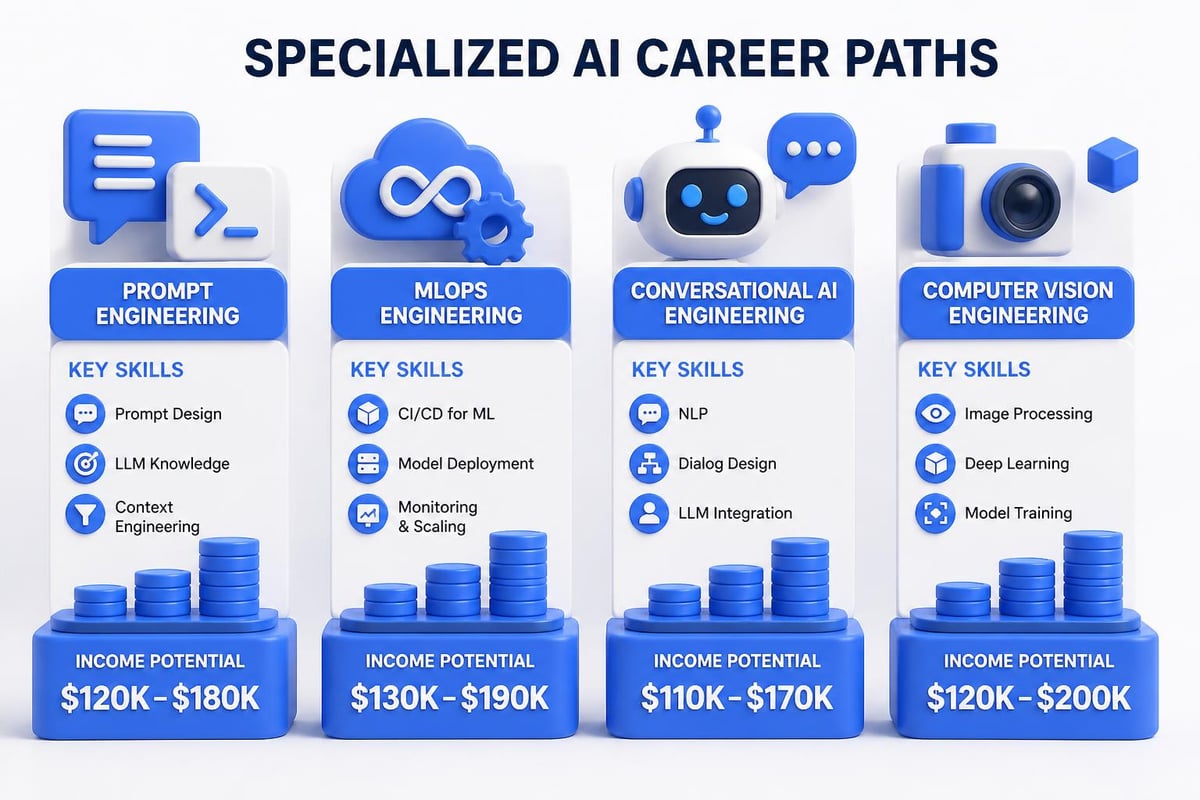
High-demand AI niches include:
- Prompt engineering and large language model optimization
- AI workflow automation for specific industries (healthcare, finance, legal)
- Machine learning operations (MLOps) and model deployment
- Conversational AI and chatbot development
- AI ethics and responsible implementation
- Computer vision for specific applications (manufacturing, retail, security)
Each of these niches requires focused knowledge that takes months to develop but can immediately differentiate you in the job market. Unlike broad "AI engineer" positions facing intense competition, these specialized roles often have more openings than qualified candidates.
For professionals looking to transition into these high-paying AI specializations, structured training provides the fastest path to expertise. The AI Certification Program – Mammoth Club offers hands-on experience with real-world AI workflows and automation tools, helping you build the specific skills employers are actively seeking rather than generic theory.

Building Expertise That Commands Premium Pay
Developing a niche career isn't about taking one course and claiming expertise-it's about systematically building deep, demonstrable knowledge that organizations can't easily find elsewhere. The most successful specialists combine theoretical understanding with practical application experience that produces measurable results.
Your specialization roadmap should include:
- Foundational knowledge: Master core concepts in your chosen niche through structured learning
- Hands-on projects: Build portfolio pieces demonstrating real-world problem-solving
- Industry certifications: Earn recognized credentials that validate your expertise
- Continuous learning: Stay current as tools and best practices evolve
- Community engagement: Connect with other specialists to share insights and opportunities
The key is depth over breadth. Rather than superficially understanding ten AI tools, become the expert who can optimize and deploy two tools better than anyone else in your market. Developing niche skills for career growth requires intentional focus on mastery rather than accumulation.
Practical Strategies for Skill Development
Building a niche career requires more than passive learning-you need active skill application that creates tangible proof of expertise. Employers hiring for specialized roles want to see concrete evidence that you can solve their specific problems, not just theoretical knowledge.
Start with projects that mirror real business challenges. If you're specializing in AI-powered customer service automation, build working chatbot systems that demonstrate conversation flow design, integration capabilities, and performance optimization. Document your process, showcase results, and explain the business impact.
Effective skill-building approaches include:
- Reverse-engineer successful implementations in your niche
- Contribute to open-source projects demonstrating your specialized knowledge
- Create detailed case studies showing problem-solving methodology
- Build tools or frameworks that other professionals in your niche can use
- Teach or mentor others to solidify and showcase your expertise
Career development strategies for 2026 emphasize the importance of niche skill mastery as markets become increasingly specialized. The professionals who thrive aren't those with the most certifications-they're the ones who can prove they deliver results in specific, high-value contexts.
Marketing Yourself as a Niche Specialist
Having expertise means nothing if the right employers don't know you exist. Successfully building a niche career requires strategic self-promotion that positions you as the obvious choice for specialized roles rather than another applicant in a crowded field.
Your professional brand should immediately communicate three things: your specific specialization, the problems you solve, and the results you deliver. Generic LinkedIn headlines like "AI Enthusiast" get ignored. Specific positioning like "MLOps Specialist | Reducing Model Deployment Time by 60% for FinTech Companies" gets interview requests.
Essential elements of niche positioning:
- Specialized job titles that signal focused expertise
- Results-driven descriptions quantifying your impact
- Industry-specific language demonstrating insider knowledge
- Portfolio pieces showcasing relevant problem-solving
- Thought leadership content establishing authority
Explore specialized job boards and niche industry platforms where employers specifically seek specialists rather than competing on general platforms flooded with applicants. These focused channels often yield better opportunities with less competition.
Networking Within Your Specialization
The most lucrative opportunities in niche careers come through specialized networks rather than broad job boards. When you're known within a specific community as the expert in conversational AI for healthcare or supply chain optimization using machine learning, opportunities find you.
Invest time in communities, forums, and professional groups focused specifically on your niche. Answer questions, share insights, and demonstrate expertise publicly. This organic authority-building creates inbound opportunities that don't require traditional job applications.
| Networking Channel | Effort Required | Opportunity Quality | Timeline to Results |
|---|---|---|---|
| General Job Boards | Low | Low to Moderate | Immediate but competitive |
| Niche Communities | Moderate | High | 3-6 months |
| Industry Events | High | Very High | 6-12 months |
| Thought Leadership | Very High | Extremely High | 12+ months |

Pivoting Into a Niche Career From General Roles
Many professionals worry that specialization limits flexibility, but the opposite is true. A well-chosen niche career provides both higher earning potential and greater long-term adaptability because your deep expertise transfers across industries while your specialized skills remain valuable.
Transitioning from a generalist position to a specialized role doesn't require starting over. It means strategically repositioning your existing experience while rapidly developing focused skills that employers can't easily find. Professionals pivoting careers after years in specialized fields successfully make these transitions by identifying transferable knowledge and building bridges to new specializations.
Successful pivot strategies include:
- Identify overlaps between current skills and target niche
- Pursue targeted training in specific gap areas
- Create portfolio projects demonstrating new specialization
- Leverage existing industry knowledge as differentiator
- Network within target specialty before officially transitioning
If you're currently in traditional tech roles but interested in artificial intelligence as a career path, your existing programming, data analysis, or system design experience provides valuable foundation. The key is layering specialized AI knowledge on top of those transferable skills rather than rebuilding from scratch.
Overcoming Transition Challenges
The biggest obstacle in developing a niche career isn't skill development-it's the psychological barrier of leaving generalist safety for specialized positioning. Many professionals fear that narrowing focus will limit options, but market data proves the opposite: specialists enjoy more opportunities within their domain than generalists competing for everything.
Address transition anxiety by building your niche expertise while still employed in your current role. Dedicate evenings and weekends to focused learning, project-building, and community engagement in your target specialization. Once you've developed demonstrable skills and built initial network connections, the transition becomes natural rather than risky.
Organizations increasingly value specialized career paths and unconventional expertise over traditional generalist backgrounds. Your unique combination of existing experience plus focused specialization creates positioning that generic candidates can't match.
Maximizing Income Growth Through Specialization
The ultimate goal of building a niche career is maximizing both immediate compensation and long-term earning potential. Specialized knowledge creates multiple income streams beyond traditional employment, from consulting to training to creating tools and resources for others in your niche.
Experts in emerging AI applications regularly command consulting rates of $200-500 per hour because they solve problems their clients can't address internally. This income potential exists only when you're recognized as a genuine specialist rather than a generalist dabbling in multiple areas.
Monetization opportunities for niche specialists:
- Premium salary positions with direct hiring
- High-rate consulting and fractional work
- Training and educational content creation
- Tool development and software products
- Speaking engagements and workshops
- Advisory roles for startups and enterprises
Looking at the highest-paying AI jobs in 2026, the common thread isn't just AI knowledge-it's specialized expertise in specific applications that deliver measurable business value. Companies don't pay premium rates for general AI understanding; they pay for experts who can implement, optimize, and scale specific solutions.
Negotiating as a Specialist
Your specialized positioning transforms salary negotiations from competitive discussions into value-based conversations. When you're one of few candidates who can genuinely solve a specific problem, you're not competing on price-you're demonstrating unique value.
Research market rates for your specific niche rather than general industry benchmarks. A "machine learning engineer" might average $120,000, but a "machine learning engineer specializing in recommendation systems for streaming platforms" can command $180,000+ because the specialization directly impacts revenue.
Document and quantify the business impact of your specialized skills. When you can show that your expertise in AI-powered customer segmentation increased conversion rates by 40% or reduced churn by 25%, salary discussions become ROI calculations rather than negotiations.
Staying Relevant in Your Niche Career
Specialization doesn't mean stagnation-it means focused evolution within your chosen domain. The most successful niche career professionals continuously deepen their expertise as their field advances, maintaining their competitive advantage through deliberate skill updates and strategic learning.
Emerging fields like artificial intelligence evolve rapidly, with new tools, frameworks, and best practices emerging monthly. Staying current requires systematic professional development focused specifically on your specialization rather than scattered learning across multiple domains.
Maintain expertise through:
- Regular engagement with specialized research and publications
- Experimentation with new tools within your niche
- Participation in specialized conferences and workshops
- Collaboration with other experts in your field
- Teaching and content creation that forces deeper understanding
For those exploring jobs that offer high pay without extensive prior experience, building a niche career in emerging AI applications provides the fastest path because the field is new enough that deep specialization can be developed relatively quickly compared to established professions.
The key is choosing a niche with both current demand and future growth potential, then committing to becoming truly excellent within that focused domain rather than perpetually starting over in new areas.
Building a niche career isn't just about finding your place in the market-it's about creating a position of strength through specialized expertise that commands premium compensation and provides long-term security. By focusing your skills on high-value areas like AI automation, prompt engineering, or machine learning operations, you transform from a replaceable generalist into an indispensable specialist. AI Career Central provides the step-by-step career paths, practical training, and certification guidance you need to transition into these specialized, high-paying AI roles and stay competitive as the industry evolves. Start building your niche expertise today and unlock the income potential that specialization creates.